TensorRT-LLM Sidecar
Run Dynamo beside a TensorRT-LLM engine through its OpenEngine gRPC API.
Experimental. The sidecars and their deployment examples are experimental. Manifests, flags, and behavior may change without notice.
dynamo-trtllm-sidecar connects a Dynamo worker to TensorRT-LLM’s OpenEngine
gRPC server. See Sidecar Backends
for the architecture.
For the best and latest support, use the upstream TensorRT-LLM nightly image,
which carries the latest gRPC server updates. Nightly builds are the
nvcr.io/nvidia/tensorrt-llm/release:<version>.dev<date> tags on
NGC.
KV routing is available in
nvcr.io/nvidia/tensorrt-llm/release:1.4.0a0.dev202610180820, which includes
native KVCM2 event streaming and OpenEngine routing load support.
Support Matrix
Launch Locally
See lib/sidecar/trtllm/launch/
for all topologies. For example, aggregated serving on one GPU:
In a second terminal:
Deploy on Kubernetes
See lib/sidecar/trtllm/deploy/
for all manifests. For example, aggregated serving:
Before applying, replace <your-registry>/dynamo-sidecar in the manifest with a
sidecar image and create the hf-token-secret
Secret that the manifest reads.
Multinode deployments require complete leader and worker role PodTemplates. Set
backendFramework: trtllm as the examples do: the operator does not infer a backend from a
native engine launch, and on Grove it starts the leader clique after the worker clique only
when the backend is known. The templates own the MPI launch, the SSH setup, the
engine probes, and the sidecar placement. In sidecar mode the operator does not apply
its TensorRT-LLM SSH key mount, mpirun wrapper, or worker probe rewrite. See the
TP example,
where the leader launches every rank with mpirun over SSH and runs the only sidecar,
and the attention-DP example,
where every rank publishes KV events on its own node, so the worker also runs a
sidecar that relays its local events under the leader’s worker identity through
OpenEngine’s follower metadata endpoint. Engine-failure KV recovery remains incomplete
and is tracked in DEP #14897.
The leader runs trtllm-llmapi-launch trtllm-serve --grpc --grpc-protocol openengine --host 0.0.0.0 and uses Kubernetes gRPC probes against the standard health service:
liveness for the startup and liveness probes, inference for readiness. That service
is in TensorRT-LLM nightlies from 2026-10-27; node-local discovery and native KV events
need 1.4.0rc1 or later. Worker main containers run sshd for the MPI launch and carry
no probes: the leader waits for sshd, and losing sshd or a rank aborts mpirun and
restarts the leader. The release images ship no sshd, so the examples install
openssh-server at start, and they export the container environment to sshd sessions
so Triton JIT on the worker finds CUDA. TensorRT-LLM attention DP requires untied input
and output embeddings; the DP example serves TinyLlama/TinyLlama-1.1B-Chat-v1.0.
The multinode examples bind the OpenEngine listener to every Pod interface so the
kubelet can probe it. The listener is unauthenticated: any client that reaches the
Pod IP can run inference and abort requests. Restrict it with a NetworkPolicy, or
bind 127.0.0.1 and use exec probes as agg_kv_router.yaml does.
The examples use DYNAMO_RANK and DYNAMO_LEADER_ADDRESS, which exist only in
DGDs created by operator 1.6.0 or later. For an older DGD, see
Use the variables in a DGD created before 1.6.0.
Topologies
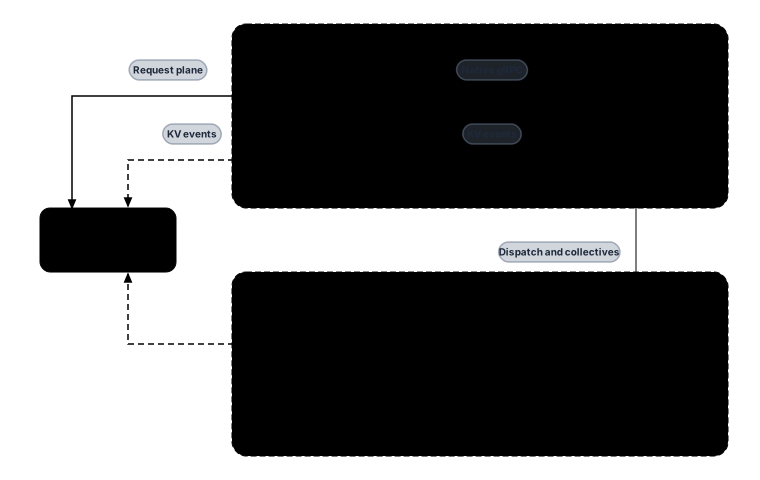
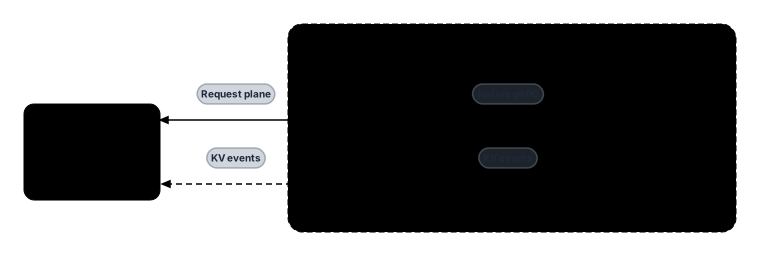
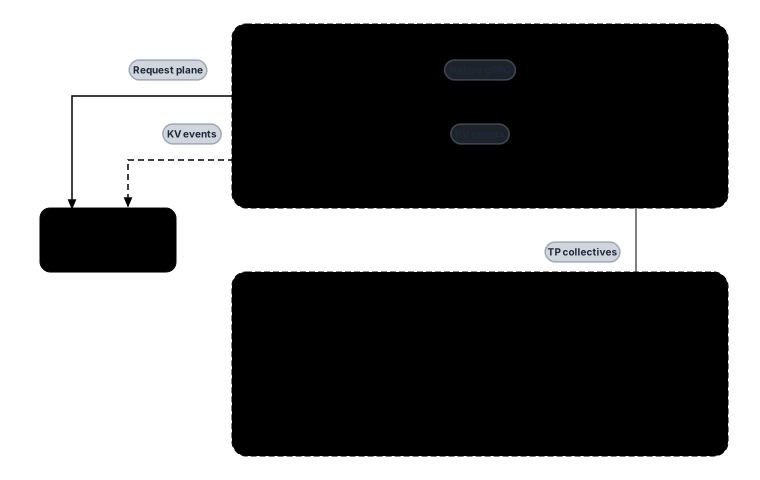
The frontend sends inference requests to each engine’s leader sidecar, which forwards them to OpenEngine over gRPC and polls routing load for all attention-DP ranks. Each sidecar discovers its node’s KV event sources through OpenEngine and relays local KV events through Dynamo’s event plane. Follower sidecars do not serve inference requests.
Single-Node TP
One engine on one node, with one sidecar.
Multi-Node TP
One engine spans two nodes. Only the leader node has a sidecar; the follower node holds the remaining TP ranks.
Multi-Node DP
Every rank publishes KV events on its own node. The leader sidecar registers all ranks and serves requests; a worker sidecar relays its node-local events without serving. The sidecar forwards the selected attention-DP rank to OpenEngine for KV-aware routing when the engine has more than one attention-DP rank. For single-rank engines, it omits the redundant rank hint and does not synthesize a conversation ID for anonymous requests. Explicit session IDs are preserved.
For multi-rank engines with conversation affinity enabled, OpenEngine currently requires a conversation ID with a rank hint. The sidecar supplies a request-scoped ID when the client provides no session. With KVCM2 block_reuse_config.policy: per_conversation, those one-shot IDs can retain conversation state until cache reset or engine restart, causing host memory to grow with anonymous request count. Avoid this combination for sustained anonymous traffic until TensorRT-LLM accepts rank hints without conversation IDs or bounds retained conversation state.