vLLM Sidecar
Experimental. The sidecars and their deployment examples are experimental. Manifests, flags, and behavior may change without notice.
dynamo-vllm-sidecar connects a Dynamo worker to vLLM’s native gRPC server
(vllm-rs). See Sidecar Backends
for the architecture.
For the best and latest support, use the upstream vLLM nightly image,
which carries the latest gRPC server updates: vllm/vllm-openai:nightly.
Support Matrix
Launch Locally
See lib/sidecar/vllm/launch/
for all topologies. For example, aggregated serving on one GPU:
In a second terminal:
Deploy on Kubernetes
See lib/sidecar/vllm/deploy/
for all manifests. For example, aggregated serving:
Before applying, replace <your-registry>/dynamo-sidecar in the manifest with a
sidecar image.
Multinode deployments require complete leader and worker role PodTemplates. Set
backendFramework: vllm as the examples do: the operator does not infer a backend from
vllm serve, and compilation-cache defaults and inter-pod GMS admission depend on it.
The templates own the native engine commands and sidecar placement. The operator does
not inject executor or coordination flags.
See the TP example,
which uses the multiprocessing executor with a sidecar on the leader only, and the
hybrid-LB DP example,
where every Pod runs a sidecar for its local DP ranks. Unlike agg.yaml, which
launches vllm-rs serve, both multinode examples launch their serving ranks with
vllm serve --grpc-port and VLLM_USE_RUST_FRONTEND=1. The TP worker runs
vllm serve --headless. That entry point needs vLLM v0.32.0 or later. The examples
use it because vllm-rs serve does not support --data-parallel-hybrid-lb.
Engine-failure KV recovery remains incomplete and is tracked in
DEP #14897.
A multinode engine starts only when every rank has joined, and vLLM gives a late
rank 600 seconds by default. Two timeouts set that budget. The Rust frontend waits
VLLM_ENGINE_READY_TIMEOUT_S for its engine cores to register, and torch waits
--distributed-timeout-seconds for the cross-node rendezvous on both the leader
and the worker. When either expires, the leader’s main container exits with
engine input registration timed out or a store timeout and restarts. The sidecar
is not affected. The TP example sets both to 1800 seconds, which matches the
sidecar’s startup deadline and the example’s startup probe, so a worker Pod that
pulls the engine image on a cold node still joins the first attempt. The torch
timeout also bounds collectives at run time, so a wedged NCCL call surfaces after
30 minutes instead of 10.
The examples use DYNAMO_RANK and DYNAMO_LEADER_ADDRESS, which exist only in
DGDs created by operator 1.6.0 or later. For an older DGD, see
Use the variables in a DGD created before 1.6.0.
In sidecar mode the operator injects only the topology variables into main, not
the vLLM-specific environment. A disaggregated role template must set
VLLM_NIXL_SIDE_CHANNEL_HOST from status.podIP on its main
container, as disagg.yaml does, so the decode engine can reach the prefill
engine’s NIXL handshake listener. vLLM adds each engine’s global data-parallel
index to the side-channel port.
Topologies
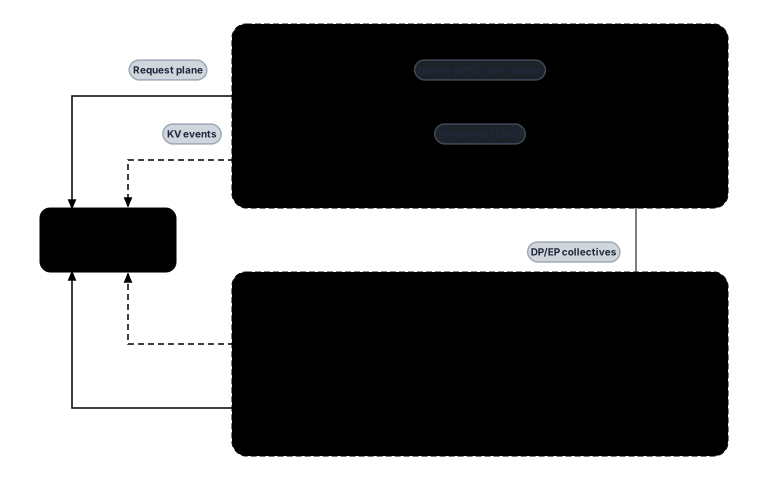
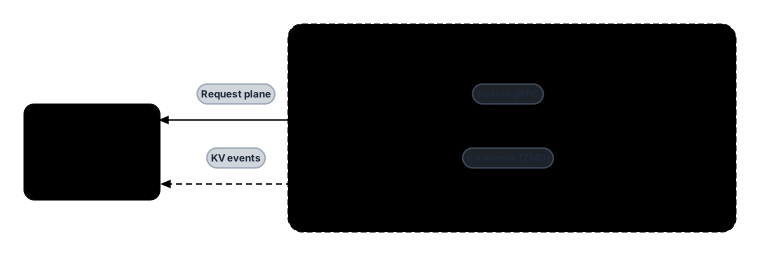
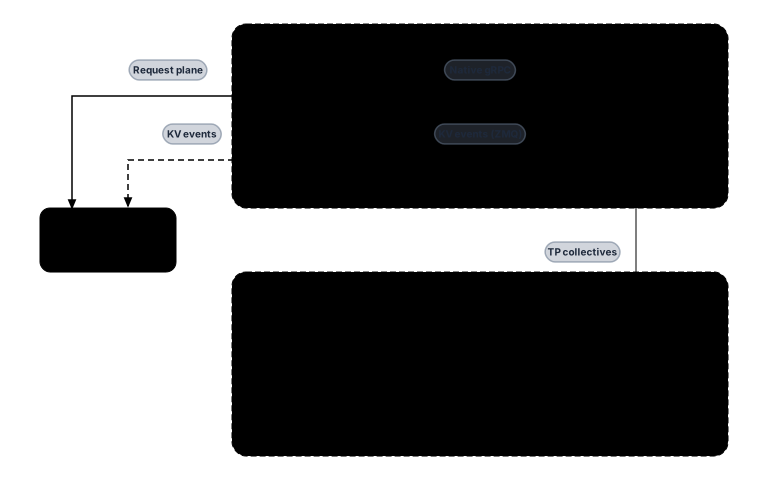
The frontend reaches each sidecar over Dynamo’s request, discovery, and event planes; the sidecar reaches the engine over its native gRPC API. Dashed arrows carry KV events.
Single-Node TP
One engine on one node, with one sidecar.
Multi-Node TP
One engine spans two nodes. Only the leader node has a sidecar; the follower node holds the remaining TP ranks.
Multi-Node DP
Hybrid DP load balancing: each node runs vLLM for its local DP ranks plus a sidecar that serves requests. The frontend routes to either node.