For AI agents: a documentation index is available at the root level at /llms.txt. Append /llms.txt to any URL for a page-level index, or .md for the markdown version of any page.
This page is for version dev.
For other versions, use one of these documentation indexes:
- Latest (v1.6.1) (default): https://docs.dynamo.nvidia.com/dynamo/latest/llms.txt
- dev: https://docs.dynamo.nvidia.com/dynamo/dev/llms.txt
- v1.6.1: https://docs.dynamo.nvidia.com/dynamo/v1.6.1/llms.txt
- v1.6.0: https://docs.dynamo.nvidia.com/dynamo/v1.6.0/llms.txt
- v1.5.1: https://docs.dynamo.nvidia.com/dynamo/v1.5.1/llms.txt
- v1.5.0: https://docs.dynamo.nvidia.com/dynamo/v1.5.0/llms.txt
- v1.4.2: https://docs.dynamo.nvidia.com/dynamo/v1.4.2/llms.txt
- v1.4.1: https://docs.dynamo.nvidia.com/dynamo/v1.4.1/llms.txt
- v1.4.0: https://docs.dynamo.nvidia.com/dynamo/v1.4.0/llms.txt
- v1.3.0: https://docs.dynamo.nvidia.com/dynamo/v1.3.0/llms.txt
- v1.2.1: https://docs.dynamo.nvidia.com/dynamo/v1.2.1/llms.txt
- v1.2.0: https://docs.dynamo.nvidia.com/dynamo/v1.2.0/llms.txt
- v1.1.1: https://docs.dynamo.nvidia.com/dynamo/v1.1.1/llms.txt
- v1.1.0: https://docs.dynamo.nvidia.com/dynamo/v1.1.0/llms.txt
- v1.0.2: https://docs.dynamo.nvidia.com/dynamo/v1.0.2/llms.txt
- v1.0.1: https://docs.dynamo.nvidia.com/dynamo/v1.0.1/llms.txt
- v1.0.0: https://docs.dynamo.nvidia.com/dynamo/v1.0.0/llms.txt
- v0.9.1: https://docs.dynamo.nvidia.com/dynamo/v-0-9-1/llms.txt
- v0.9.0: https://docs.dynamo.nvidia.com/dynamo/v-0-9-0/llms.txt
- v0.8.1: https://docs.dynamo.nvidia.com/dynamo/v-0-8-1/llms.txt
- v0.8.0: https://docs.dynamo.nvidia.com/dynamo/v-0-8-0/llms.txt
- v0.7.1: https://docs.dynamo.nvidia.com/dynamo/v-0-7-1/llms.txt
- v0.7.0: https://docs.dynamo.nvidia.com/dynamo/v-0-7-0/llms.txt
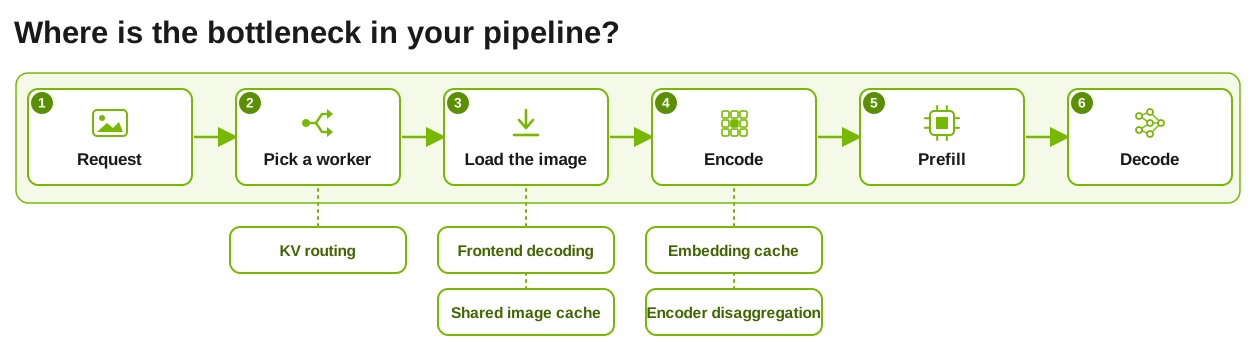
Once you can serve a VLM in Dynamo (see Image Understanding),
these features cut the time a vision language model (VLM) spends on multiple
stages in the pipeline: fetching media, finding the right worker, running the
vision encoder, and prefill. Depending on your workload characteristics, you may
benefit from using all of these features or only some of them.
When Each Feature Helps
Feature
Use it when
Supported modalities
Multimodal KV routing sends repeat requests to the worker that already holds their KV cache
The same images or clips repeat across requests and you run several workers
Vision encoding is the bottleneck, or encoders need different hardware than the LLM
Image (vLLM video stays on the PD path)
If your workload is all unique media, the caches and routing give little benefit.
Start with frontend media decoding or encoder disaggregation instead.