

Multimodal KV Routing
Overview
Multimodal KV routing extends Dynamo’s KV-aware router to account for image or video content when calculating cache overlap. The frontend assigns each supported media object a stable hash and includes its identity in the routing view of the prompt.
When media appears again, its identity contributes to each worker’s KV overlap. The router balances that cache credit against projected prefill and decode load, so the worker with the largest overlap does not necessarily win when it is busy. Cache-aware placement increases prefix reuse without abandoning load balancing.
The KV cache stores attention key/value state so a worker can skip repeated prefill work. The embedding cache stores vision encoder outputs so the encoder can skip repeated image processing. You can use both features together. See Embedding Cache.
When to Use
Use multimodal KV routing when:
- Multiple backend workers serve multimodal requests.
- Images or videos repeat across requests, such as product photos, shared reference images, or several questions about the same video.
- You want to maximize KV cache reuse for multimodal content.
Single-worker deployments do not need routing, and workloads with entirely unique media receive little media-specific cache benefit.
This section covers image routing. For video, see Exact Video KV Routing.
How It Works
The routing flow in general has three steps:
- The frontend computes a stable identity for each supported media object.
- The frontend represents the media in a routing-only token view that matches the backend’s cache identity and token layout.
- The KV router includes that overlap in its combined cache-and-load score, selects the lowest-cost eligible worker, and forwards the same media identity.
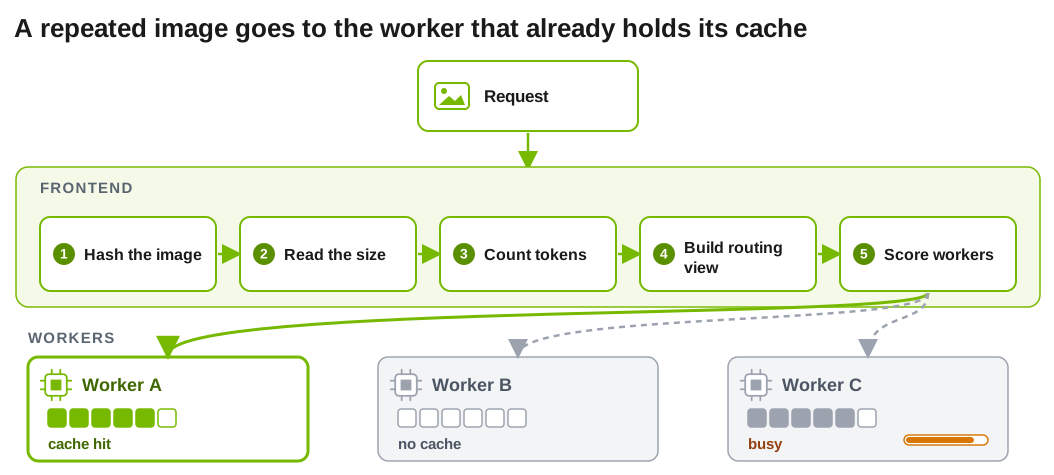
Image Identity
By default, an HTTP image’s identity hashes the exact URL bytes, including its
query string. Reusing the identical URL produces the same identity, but two URLs
for the same image bytes do not. Enable --frontend-decoding when you need
content-stable identity across URLs; the frontend then hashes decoded image
content. Data URLs follow the same rule: the default path hashes the full data
URI string, while frontend decoding hashes the decoded bytes.
vLLM
SGLang
TensorRT-LLM
vLLM provides two routing paths. Use the default Rust frontend for supported model families when you want minimal frontend processing. Use the Python chat processor when you need vLLM’s broader model support or want the frontend to preprocess media and transfer the processed inputs to workers.
Default Rust frontend
For images, the frontend calculates only the identity and routing token layout unless frontend decoding is enabled. The selected worker still runs the model’s multimodal processor. This path depends on the model being registered with Dynamo’s Rust processor registry.
Alternative: Python chat processor
With --dyn-chat-processor vllm, the frontend runs vLLM’s full multimodal processor. It derives routing positions from vLLM’s processed image or video features without requiring a Dynamo Rust processor specification and can transfer processed inputs through shared memory or NIXL. This shifts preprocessing and transfer work to the frontend.
Launch
vLLM
SGLang
TensorRT-LLM
Use the Python chat processor when you need vLLM’s model-native multimodal processor or want to transfer processed multimodal inputs from the frontend. Otherwise, use the default Rust frontend.
Default Rust frontend
Alternative: Python chat processor
See vLLM Multimodal for model support, hashing behavior, transfer modes, and configuration.
Send an Image Request
Send the same image twice. The first request populates the selected worker’s KV cache, and the second should be routed back to it while workers are idle:
Set "model" to the model your launcher serves. With
DYN_LOG=info,dynamo_kv_router::scheduling=debug,dynamo_llm::kv_router=debug, the frontend logs a
[ROUTING] Best: worker_<id> … with <n>/<total> blocks overlap line for each
request; the second request should report more overlap than the first.
Support Matrix
Nemotron 3 Nano Omni exact image and video routing currently requires the vLLM backend. Other backends fall back to text-prefix routing for this model.